 YAMAHA
 SUZUKI
 HONDA
HONDA


Best Car GPS Trackers 2026: What to Look for Before You Buy
Car GPS trackers have quietly become one of the most useful pieces of vehicle tech you can own. They recover stolen cars, keep tabs on a small delivery fleet, let parents check that a new driver arrived safely, and give you a full record of business mileage at tax time. But the market is crowded with near-identical-looking devices at wildly different prices, and the specifications that actually matter are rarely the ones on the front of the box.
First, Decide What You Actually Need It For
The right tracker looks completely different depending on the job:
- Theft recovery — needs to be hidden, hardwired, and hard for a thief to find or disable
- Fleet management — needs driver behaviour reporting, multi-vehicle dashboards, and route history
- Teen or family driver monitoring — needs speed alerts, geofencing, and simple sharing
- Mileage logging — needs accurate trip records and easy export, not real-time precision
Buying a fleet-grade device for simple mileage logging wastes money; buying a basic OBD plug-in for theft recovery wastes the device entirely, since it is the first thing a thief will unplug.
The Three Installation Types
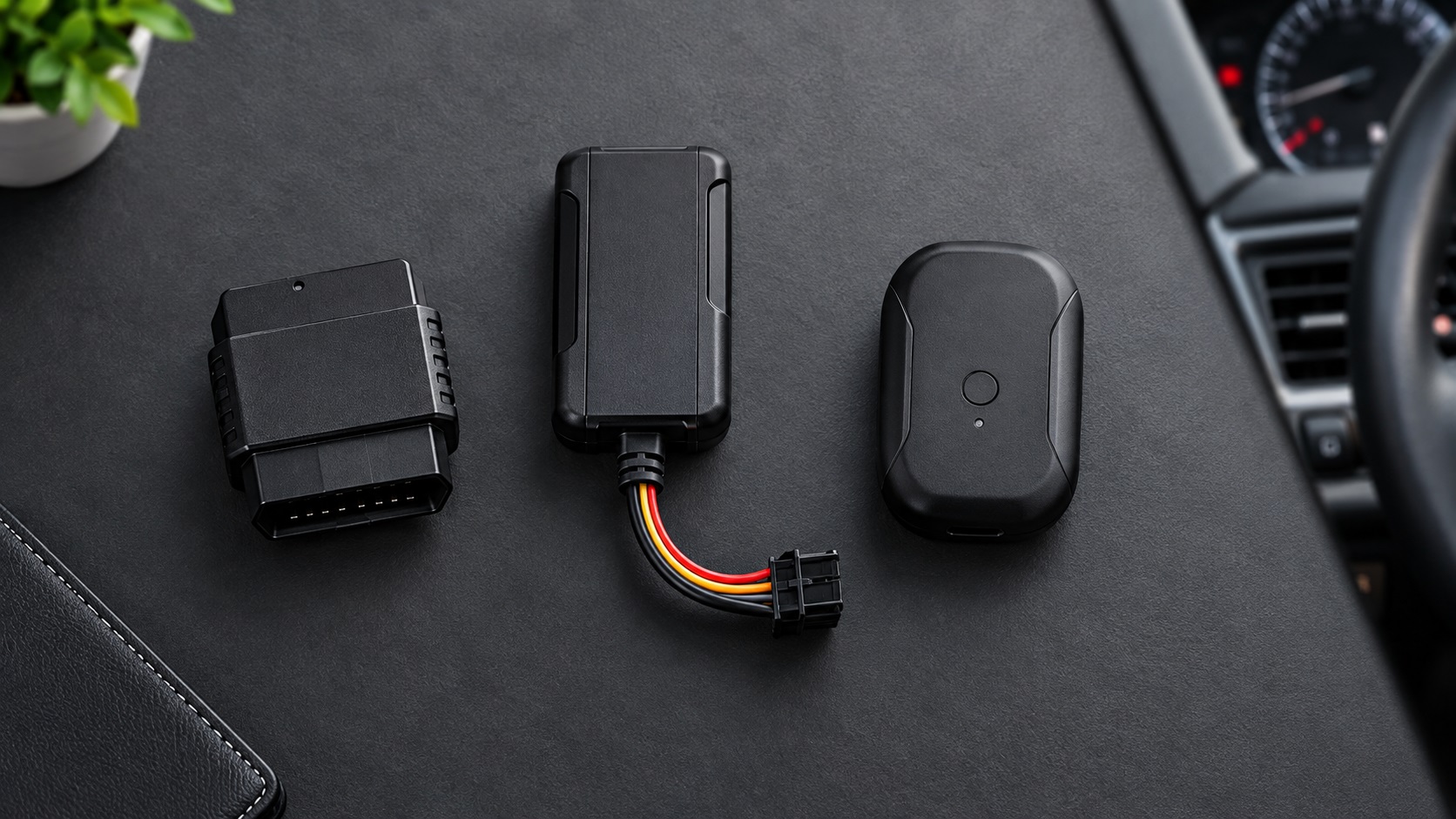
OBD-II Port Plug-In
Plugs straight into the diagnostic port under the dashboard, usually near the driver’s knees. Installation takes seconds, no tools, no wiring. It can also read engine data such as fault codes and fuel consumption.
Best for: mileage logging, family driver monitoring, basic fleet tracking.
Worst for: theft recovery — the port location is universally known and the device is visible and trivially removed.
Hardwired
Wired directly into the vehicle’s electrical system and hidden behind trim. Permanent power, no charging, and genuinely concealed.
Best for: theft recovery and serious fleet use.
Trade-off: requires proper installation, and most insurers that offer tracker discounts require professional fitting anyway.
Battery-Powered Magnetic
Self-contained units, often with a magnetic case, that can be placed anywhere — inside a wheel arch, under a seat, in the boot.
Best for: flexible placement, vehicles you don’t want to modify, backup to a hardwired unit.
Trade-off: needs recharging, and battery life claims are usually measured under very light reporting schedules.
Specifications That Actually Matter
Network Generation
This is the single most common expensive mistake. Plenty of budget trackers still ship with 2G modems, and 2G networks have been shut down in many countries with more retiring every year. Buy 4G LTE. A tracker on a dead network is not a cheap tracker — it is a dead one.
Reporting Interval
Marketing often advertises “real-time tracking” for a device that reports every few minutes. During a theft, that gap is the difference between a live chase and a cold trail. Look for devices that escalate to reporting every 10–30 seconds when an alert triggers, even if they report less often at rest to save power and data.
Total Cost Over Three Years
Nearly all trackers require a SIM and a data subscription. Run the arithmetic before buying: hardware price plus 36 months of subscription. A $30 device with a $15 monthly plan costs $570 over three years. A $150 device with a $5 plan costs $330. The cheaper-looking option is frequently the more expensive one.
Backup Battery and Tamper Alerts
For theft recovery specifically, a hardwired tracker without an internal backup battery offers weak protection — cutting vehicle power kills it. A backup cell plus a “power disconnected” alert means you learn about tampering the moment it happens.
Features Worth Paying For
- Geofencing — alerts when the vehicle enters or leaves a defined area. The most genuinely useful feature on most trackers.
- Speed alerts — valuable for family drivers and fleet duty-of-care obligations.
- Trip history — a searchable log of routes, stops, and durations, which is what makes mileage claims defensible.
- Driver behaviour scoring — harsh braking, rapid acceleration, cornering. Genuinely useful for fleets; usually overkill for one family car.
- Multi-vehicle dashboard — essential above two or three vehicles, irrelevant below that.
The Legal Side — Don’t Skip This
Tracking a vehicle you own is generally straightforward. Tracking a vehicle someone else drives is not always so simple. Laws differ substantially between countries and, in the United States, between states.
- Employees: most jurisdictions require that staff are informed a company vehicle is tracked, and many restrict tracking outside working hours
- Family members: tracking a minor child’s vehicle is usually permitted; tracking another adult without their knowledge may not be, even within a household
- Vehicles you don’t own: placing a tracker on someone else’s vehicle without consent is a criminal offence in many places
This is a genuine legal question rather than a technical one. If you are tracking anyone other than yourself, check the rules that apply where you are — the consequences of getting it wrong are considerably worse than buying the wrong device.
Frequently Asked Questions
Will a GPS tracker drain my car battery?
A properly installed hardwired tracker draws minimal current and sleeps when the vehicle is parked. If the car sits unused for long periods, use a trickle charger.
Can a car GPS tracker work without a subscription?
Broadly, no. The device needs cellular data to transmit location. Some include an initial data period in the purchase price, which is not the same as being subscription-free — check what happens when it expires.
Will it reduce my insurance premium?
Sometimes, particularly for higher-value vehicles, but insurers usually specify approved devices and professional installation. Confirm the exact requirements with your insurer before buying.
Can thieves detect a tracker?
Organised crews sometimes sweep for cellular signals or use jammers. Choosing a device that stores positions internally while jammed and uploads once clear meaningfully reduces this risk.
If you’re looking at trackers for personal safety rather than vehicles, see our guide to the best GPS trackers for elderly parents. For two-wheelers specifically, the considerations are different enough to warrant their own guide — see our motorcycle GPS tracker anti-theft guide.
This guide is general information, not legal advice. Tracking laws vary by country and jurisdiction — confirm the rules that apply to your situation before tracking any vehicle you do not personally own and drive.